Beginner’s Guide to Food-Safe Custom Printed Cookie Boxes

Why Food Safety Starts With Your Custom Printed Cookie Box
When it comes to custom printed cookie boxes: how to choose food-safe inks and materials, the answer comes down to four key decisions:
| Decision | What to Look For |
|---|---|
| Ink type | Water-based, low-migration UV-cured, or mineral oil-free offset inks |
| Material | 14–18 pt food-safe paperboard, unbleached kraft, or SBS board |
| Barrier protection | PET coatings, clay nanocomposites, or grease-resistant liners |
| Compliance | FDA 21 CFR 170–189 and/or EU EC 1935/2004 certification from your supplier |
Most cookie box buyers focus on design and cost. That’s completely understandable — but there’s a hidden risk in the print.
Inks on packaging can migrate into food. This happens when chemical substances from printing inks move through or across packaging materials and make contact with what’s inside. Research has found that up to 211 different chemical substances can migrate from printing inks, and 88% of paper and board food contact materials showed migration of at least one target chemical.
For a bakery or food brand, that’s not just a health risk. It can mean regulatory fines, product recalls, and serious damage to customer trust.
The good news? Choosing the right inks and materials from the start prevents all of it.
I’m Adam John, a backlinking and packaging content expert with hands-on experience helping food brands navigate custom printed cookie boxes: how to choose food-safe inks and materials — from regulatory compliance to supplier selection. In the sections below, I’ll walk you through everything you need to make confident, compliant packaging decisions.
Custom Printed Cookie Boxes: How to Choose Food-Safe Inks and Materials terms at a glance:
Understanding the Science of Ink Migration in Cookie Packaging
To master custom printed cookie boxes: how to choose food-safe inks and materials, we first need to understand the “enemy”: ink migration. This is the scientific term for when chemicals from the outside of your box end up inside your cookies. It isn’t just about the ink being wet; even dry, “cured” ink can move.
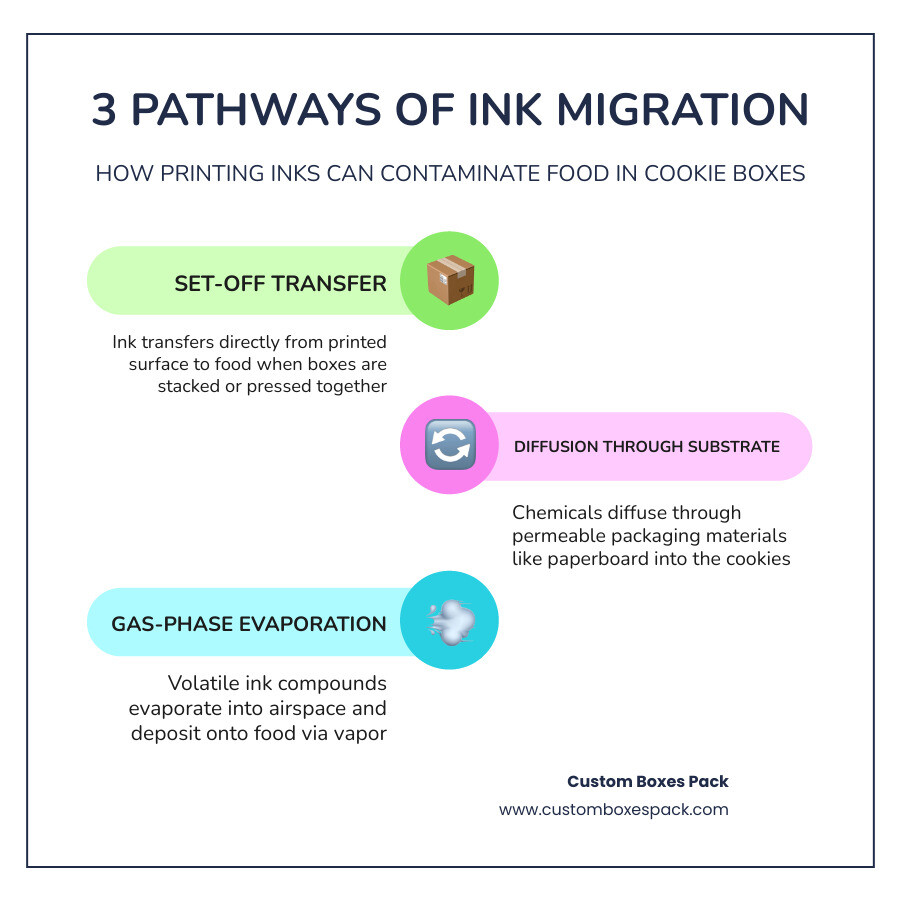
There are three main ways this happens:
- Set-off Transfer: This occurs when boxes are stacked or rolled during production. The printed outer side of one box presses against the unprinted inner side of another. If the ink isn’t perfectly cured, it “sets off” onto the food-contact surface.
- Diffusion: This is a slower, sneakier process. Chemicals literally soak through the paperboard or cardboard fibers over time. Because cookies are often high in fats and oils, they can actually pull these chemicals through the substrate more quickly.
- Gas-phase Evaporation: Some ink components are volatile. They turn into gas inside the sealed box and then condense onto the food. This is often why a box might have a “chemical” smell when first opened.
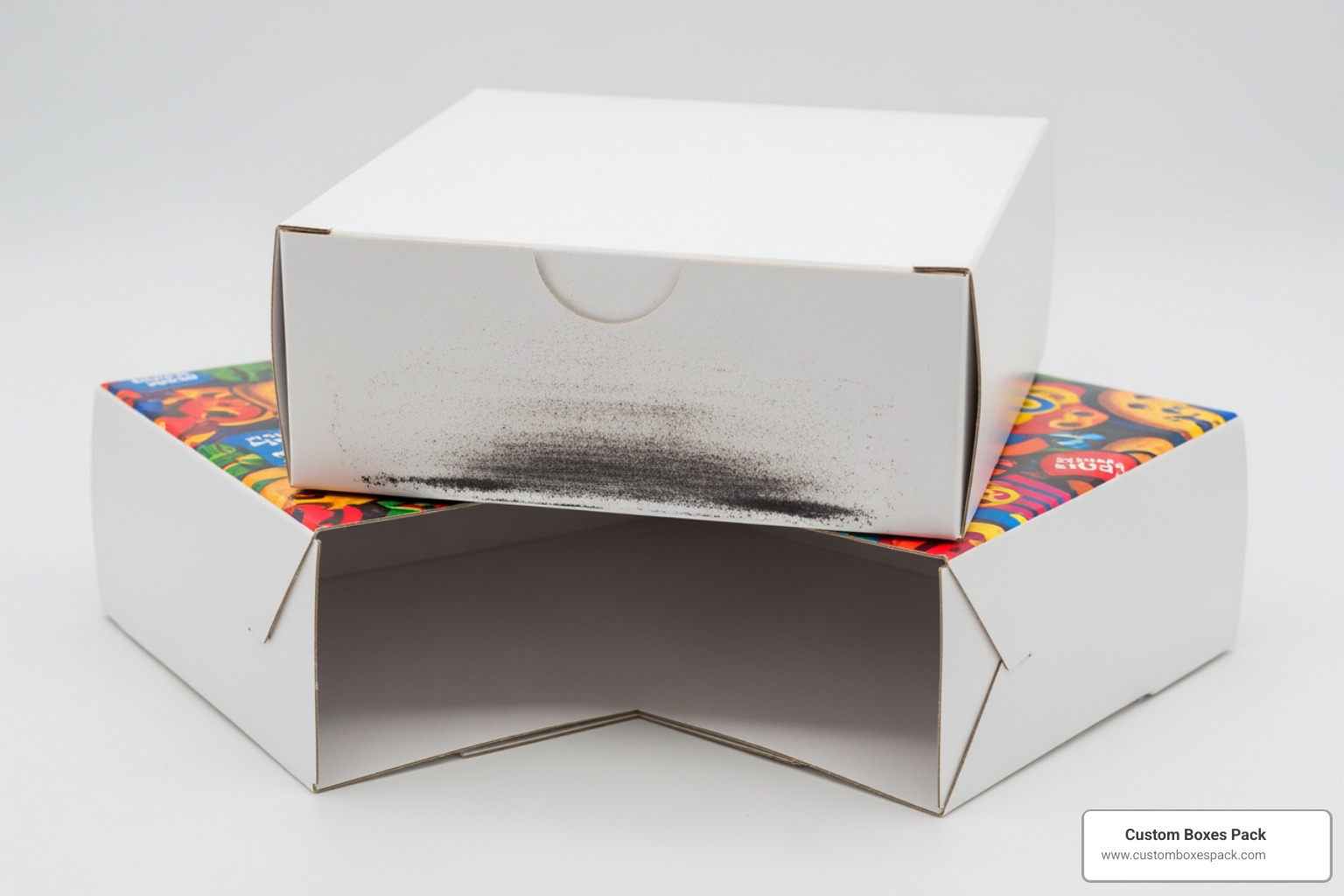
According to Food-Safe Printing Inks: What You Need to Know, substrate permeability is a major factor. If you use a very porous material without a functional barrier, the risk of migration increases significantly. Adulteration risks are real; even small amounts of non-food-grade chemicals can alter the taste and safety of your product.
Custom Printed Cookie Boxes: How to Choose Food-Safe Inks and Materials
When we talk about “food-safe” inks, we are generally referring to low-migration formulations. These inks are designed with larger molecules that are physically too big to easily “wiggle” through the packaging fibers.
Here are the heavy hitters in safe printing:
- Water-Based Inks: These are the gold standard for safety. They have a migration potential of less than 1 ppb (part per billion). They are odor-neutral and have low VOC (Volatile Organic Compound) emissions, making them perfect for the unboxing experience.
- Low-Migration UV-Cured Inks: These are cured instantly using UV light. Because they harden so fast, there is less chance for the ink to remain “mobile.” They typically show migration levels under 10 ppb.
- Mineral Oil-Free Inks: Traditional offset inks often contain mineral oils (MOSH/MOAH) which are notorious for migrating into dry foods like cookies. Mineral oil-free versions use vegetable oils instead, keeping MOAH levels below 2 mg/kg.
- Soy-Based Pigments: Derived from renewable soybeans, these inks offer vivid colors and are much easier to recycle than petroleum-based alternatives.
Choosing these safer options isn’t just about health; it’s about quality. You can find more info about safer packaging options that explain how these choices also help elongate the shelf life of your treats.
Selecting the Right Inks for Custom Printed Cookie Boxes: How to Choose Food-Safe Inks and Materials
If you want to go a step further, look into vegetable-based inks and even edible ink technology. While edible inks are usually used for direct printing on the cookie itself, they represent the peak of pigment stability. For your Custom Cookie Retail Boxes, high molecular weight components are your best friend because they ensure the pigments stay exactly where the printer put them.
Material Durability in Custom Printed Cookie Boxes: How to Choose Food-Safe Inks and Materials
Safety isn’t just about the ink; it’s about the “wall” between the ink and the cookie. For most cookies, we recommend a 14–18 pt paperboard. If you are selling heavy “jumbo” cookies or large multipacks, you might need to go up to 24 pt or 28 pt for structural integrity.
Grease resistance is non-negotiable for cookies. Without a grease barrier, the butter in your cookies will soak into the paper, creating unsightly spots and potentially “wicking” ink chemicals back into the food. Our Custom Kraft Cookie Boxes are a popular choice because they offer a natural look while being compatible with modern grease-resistant coatings.
Regulatory Standards and Safety Testing for Food Contact
Navigating the legal side of custom printed cookie boxes: how to choose food-safe inks and materials can feel like alphabet soup, but it’s vital for staying in business.
In the USA, the FDA 21 CFR 170–189 is the primary regulation. It sets a migration limit of ≤ 0.5 ppb for certain substances. If you’re selling in the EU, you’ll need to follow EC 1935/2004, which limits migration to ≤ 10 ppb for non-evaluated substances. And don’t forget California Proposition 65, which has even stricter requirements for chemical transparency.
| Regulation | Region | Key Requirement |
|---|---|---|
| FDA 21 CFR 170–189 | USA | Migration limit ≤ 0.5 ppb for specific substances |
| EU EC 1935/2004 | Europe | Migration limit ≤ 10 ppb for non-evaluated substances |
| Swiss Ordinance | Global (De Facto) | Strict “positive list” of permitted ink components |
| California Prop 65 | California, USA | Warnings for chemicals known to cause cancer/birth defects |
To ensure compliance, we use advanced testing methods like:
- GC-MS (Gas Chromatography-Mass Spectrometry): Detects volatile substances.
- LC-MS/MS: Used for non-volatile substances.
- Sensory Testing: Human experts literally smell and taste (indirectly) to ensure the packaging doesn’t change the cookie’s flavor profile.
According to Inks for Food Packaging: Standards & Guidelines, maintaining Good Manufacturing Practices (GMP) is essential to prevent “set-off” during the printing process.
Essential Materials and Barrier Coatings for Freshness
The material you choose is the foundation of your safety strategy. Here are the most common options we provide:
- Solid Bleached Sulfate (SBS): This is a premium, bright white board. It’s very low in odor and provides a clean surface for high-quality printing.
- Unbleached Kraft: This is the “earthy” brown option. It’s incredibly strong and eco-friendly. Check out our Kraft Cookie Boxes for a sustainable vibe.
- Corrugated E-flute: Perfect for shipping or subscription boxes. It offers extra cushioning and can be “pasted” with a thinner printed board on the outside for a premium look.
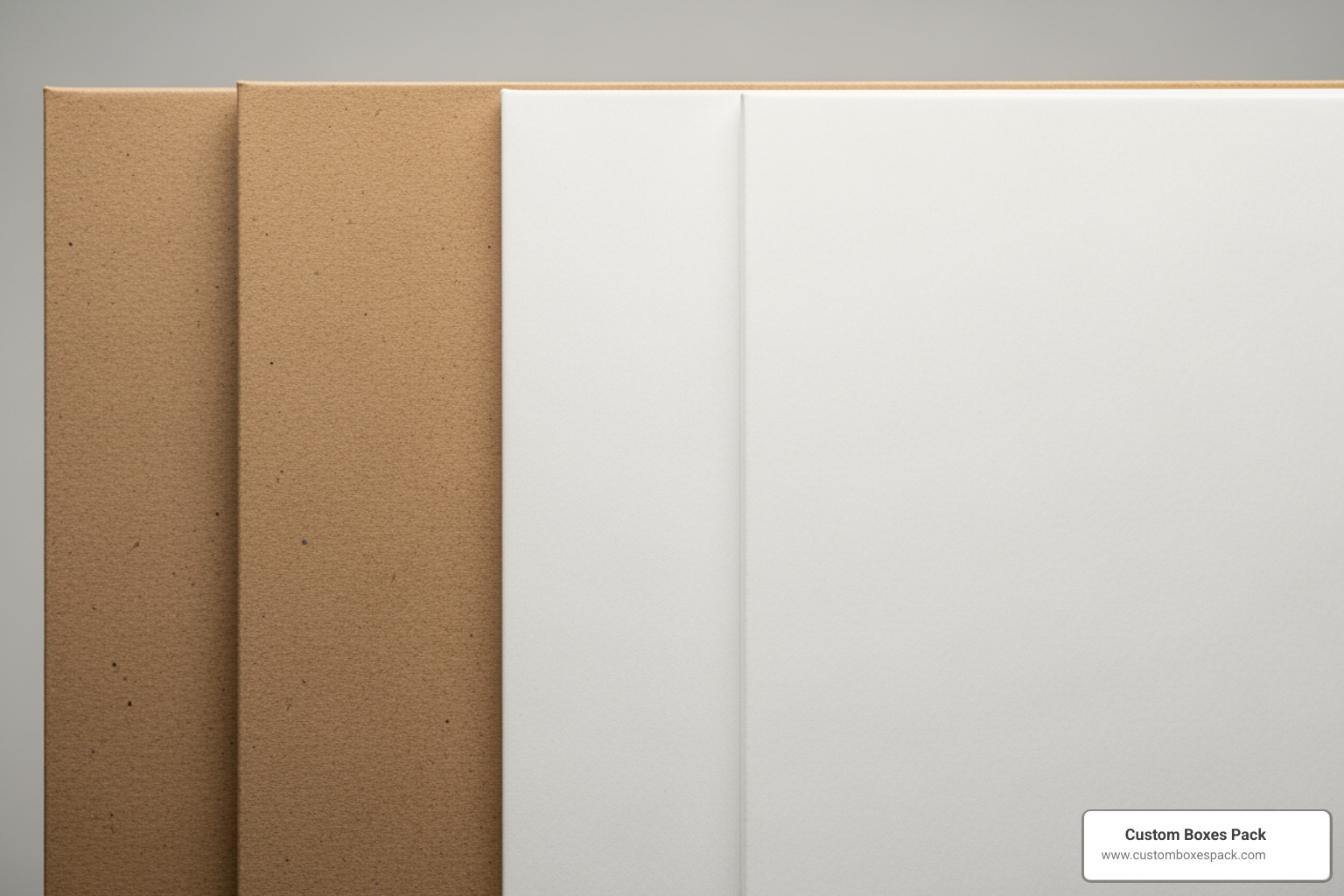
To stop migration in its tracks, we often apply barrier coatings. A PET or metallized film can reduce ink migration by up to 99%. For those who want to stay eco-friendly, clay nanocomposites are an emerging tech that can increase a material’s resistance to gas and moisture by 10 to 100 times. You can read more about Cardboard Packaging and Their Role in Providing Safer Encasing to see how these layers work.
For visibility, many brands use windows. While plastic is traditional, cellulose windows are a fantastic food-safe, compostable alternative that still lets customers see your delicious cookies.
Design Strategies to Minimize Chemical Transfer Risks
Smart design can actually make your packaging safer. Here are a few “pro tips” we use at Custom Boxes Pack:
- Reverse Printing: This is common in film packaging where the ink is printed on the inside of a outer layer, so there is a physical plastic barrier between the ink and the food.
- Low Ink Coverage: Try to keep your ink coverage under 40% of the total surface area. Minimalist designs aren’t just trendy; they are technically safer because there is less chemical volume on the box.
- Non-Food Contact Surfaces: Whenever possible, keep heavy branding and dark colors on the outside of the box only.
- Dieline Optimization: Ensure your box folds in a way that prevents printed edges from touching the cookies directly. Using Custom Cookie Boxes with custom-fit inserts ensures the cookies stay centered and don’t rub against the walls of the box.
If you are curious about the technical side, our guide on How to Make a Custom Box breaks down how we align these design choices with safety standards.
Frequently Asked Questions about Food-Safe Cookie Packaging
What is the safe migration limit for food packaging inks?
In the United States, the FDA generally looks for substances to be below 0.5 parts per billion (ppb) for them to be considered “not a food additive.” In the EU, the limit for non-evaluated substances is typically 10 ppb. Using low-migration inks is the best way to hit these targets.
How do I know if my cookie box material is FDA-compliant?
You should always ask your supplier for a “Declaration of Compliance” (DoC). This document certifies that the materials and inks used have been tested against FDA 21 CFR standards. At Custom Boxes Pack, we prioritize transparency and provide this documentation for our food-grade orders.
Are eco-friendly inks like soy-based options always food-safe?
Not necessarily. While soy inks are more sustainable and have lower VOCs, “eco-friendly” doesn’t automatically mean “low-migration.” You must specifically request food-safe, low-migration soy inks to ensure they meet the regulatory standards for food contact.
Conclusion
Choosing the right packaging is about more than just a pretty logo. When you master custom printed cookie boxes: how to choose food-safe inks and materials, you are protecting your customers and your brand’s future.
From selecting water-based inks and 18 pt SBS board to implementing smart barrier coatings, every choice matters. While food-safe inks can cost 15–25% more than standard inks, the investment is a drop in the bucket compared to the cost of a product recall or a lost reputation.
At Custom Boxes Pack, we specialize in helping bakeries of all sizes — from local startups to national wholesalers — create packaging that is as safe as it is beautiful. With our low MOQs (starting at 100 units), free design support, and commitment to eco-friendly, compliant materials, we make it easy to do things the right way.
Ready to upgrade your bakery’s presentation? Order your food-safe Bakery Boxes today and let us help you bake safety into every box.
Explore more of our specialized packaging solutions: