Custom Flip Top Boxes vs Magnetic Closure Boxes: Which Is Better?

The Real Difference Between Custom Flip Top Boxes and Magnetic Closure Boxes
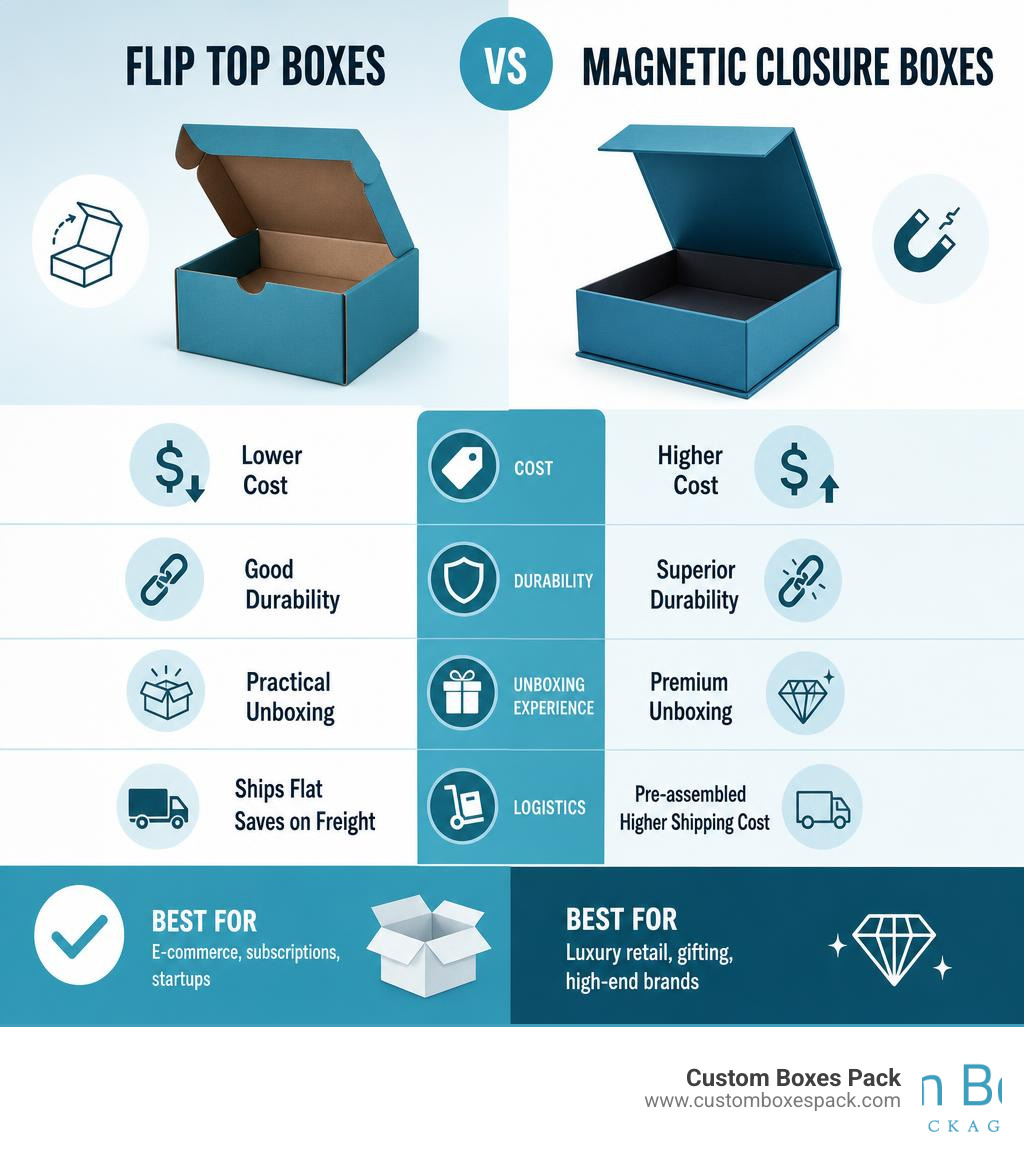
When choosing packaging, the debate around custom flip top boxes vs magnetic closure boxes: which is better comes up constantly — and the honest answer is: it depends on what you need.
Here’s a quick breakdown to help you decide fast:
| Factor | Flip Top Boxes | Magnetic Closure Boxes |
|---|---|---|
| Cost per unit | Lower ($0.50–$2.00+) | Higher ($1.20–$4.50+) |
| Shipping | Ships flat, saves up to 60% on freight | Pre-assembled, costs 35% more to ship |
| Unboxing feel | Practical, branded, theatrical | Premium, luxury, satisfying snap |
| Durability | Hinge may fatigue after ~50 cycles | Magnets hold strong after 200+ cycles |
| Best for | E-commerce, subscriptions, startups | Luxury retail, gifting, high-end brands |
| Recyclability | Highly recyclable | Recyclable after magnet removal |
Bottom line: Flip top boxes win on cost and logistics. Magnetic closure boxes win on perceived luxury and durability. Most small businesses should start with flip top — unless premium presentation is core to your brand.
Choosing the wrong box style can quietly hurt your brand. A box that pops open in transit signals poor quality. A box that feels cheap undercuts a $90 product. But overspending on rigid magnetic boxes when you’re shipping 500 subscription orders a month? That kills your margins.
This comparison cuts through the noise so you can make the right call for your product, budget, and customer.
I’m Adam John, a backlinking and packaging content expert who has spent years analyzing how packaging decisions — including the custom flip top boxes vs magnetic closure boxes: which is better debate — directly affect brand perception and operational costs for small and mid-sized businesses. In the sections below, I’ll walk you through every factor that should drive your decision.
Essential Custom Flip Top Boxes vs Magnetic Closure Boxes: Which Is Better? terms:
- How to Choose the Best Custom Flip Top Boxes for Your Products
- Bulk Custom Magnetic Boxes With Logo Packaging
- How Soap Packaging Affects Your Brand Sales (Marketing Psychology)
Structural and Functional Differences: Flip Top vs. Magnetic Closure
To truly understand how these two titans of the packaging world stack up, we have to look under the hood at their raw materials and engineering.
A classic custom flip top box is typically built from high-density paperboard or corrugated cardboard, such as E-flute or B-flute corrugated board. This makes it structurally lightweight yet remarkably resilient against external pressure. It relies on a integrated creased hinge along the back wall, closing securely using either a friction fit, a tuck-in tab, or a small front flap.
On the other hand, a magnetic closure box is a masterpiece of rigid packaging. It is constructed using a heavy-duty greyboard core (ranging from 1,500gsm to 2,000gsm, which translates to a finished wall thickness of 2mm to 3mm). This greyboard is wrapped in premium art paper or textured specialty paper. The magic happens in the front flap, where high-grade N35 neodymium magnets are carefully embedded. When the lid swings shut, these hidden magnets snap together with a crisp, satisfying “click” that feels incredibly deliberate.
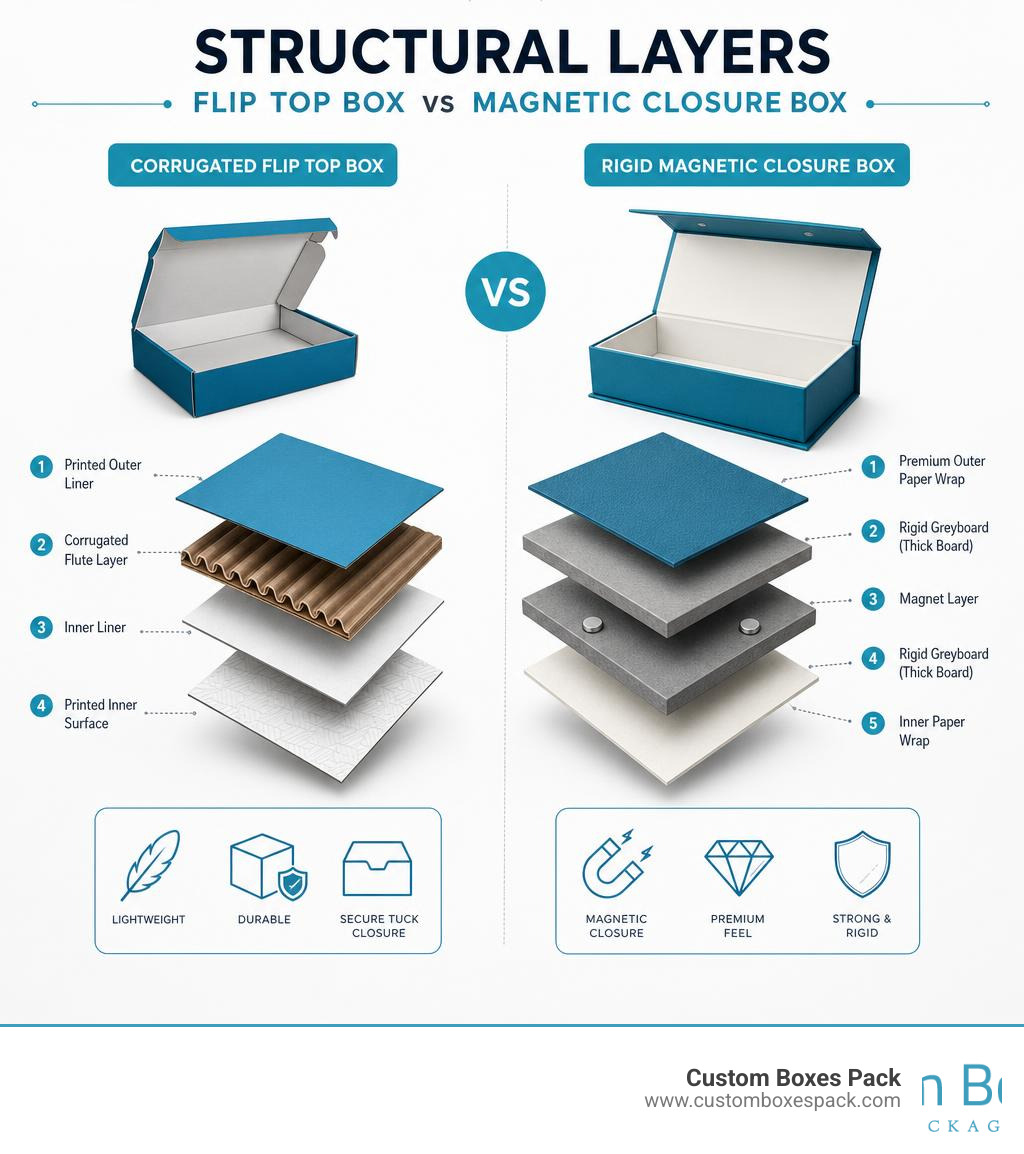
While both protect your products, they do so using completely different mechanical principles. Flip top boxes rely on the natural tension of folded paperboard to stay closed. Magnetic boxes rely on magnetic pull force, ensuring that the box remains closed regardless of minor structural warping over time.
Learn more about rigid box structures to see how different paperboard weights influence overall box strength.
Custom Flip Top Boxes vs Magnetic Closure Boxes: Which Is Better? for Structural Integrity?
When we look strictly at structural integrity, we have to talk about score lines, paper hinges, and tension cycles.
Standard paper hinges on folding flip top boxes can suffer from hinge fatigue. If a customer opens and closes a standard cardboard flip top box repeatedly, the paper fibers along the score line begin to break down. In fact, standard paper hinges can begin to crack or tear after just 50 opens unless they are engineered with double-scored folds or cloth-reinforced hinges.
Magnetic closure boxes are built to endure. Because the rigid greyboard core does not bend (the movement occurs along a wide, wrapped paper hinge that experiences minimal tension), the structural integrity remains pristine. In cycle tests, rigid magnetic boxes show no change in alignment or closing strength after 200+ cycles.
If your product is designed to be kept in its original packaging for months or years (like a luxury watch, a high-end skincare regimen, or collectible board games), the magnetic closure box is the clear winner. For items that are unboxed once and discarded, the corrugated flip top box provides more than enough structural integrity for transit.
To dive deeper into designing paperboard structures that stand up to real-world wear, check out our guide on Designing Flip Top Boxes to Capture US Consumer Attention.
Unboxing Experience and Perceived Product Value
In June 2026, retail is no longer just about the product; it is about the experience. The moment a customer receives a package in the mail or lifts it off a boutique shelf, their brain is already calculating the value of what is inside.

From a consumer psychology perspective, magnetic boxes are the gold standard. In industry surveys, 67% of consumers rate magnetic boxes as ‘much more luxurious’ than standard tuck-top boxes. Furthermore, 82% of luxury buyers rate magnetic boxes as ‘very premium’ (compared to only 48% who say the same about rigid drawer boxes).
The weight of the 2,000gsm greyboard, the smooth magnetic snap, and the book-like opening gesture combine to create a sense of high value. It tells the customer: what is inside this box is precious and deserves to be protected.
For brands aiming to charge a premium price point, investing in Magnetic Closure Boxes is one of the fastest ways to elevate your perceived product value.
Custom Flip Top Boxes vs Magnetic Closure Boxes: Which Is Better? for Brand Presentation?
While magnetic boxes hold the crown for pure luxury, custom flip top boxes are incredibly powerful tools for creative brand presentation.
Because flip top boxes start as flat sheets of corrugated board or SBS paperboard, they offer a massive canvas for interior printing. When a customer flips open the lid, you can present them with a beautifully printed message on the inside lid—a prime piece of marketing real estate. This creates a highly theatrical, stage-like reveal of your product.
+------------------------------------------+
| YOUR BRAND MESSAGE HERE |
| "We're so glad you're here..." |
+------------------------------------------+
| |
| [ PRODUCT INSERT ] |
| |
+------------------------------------------+
When paired with custom inserts—such as precision-cut cardboard platforms, molded pulp trays, or velvet-flocked foam—flip top boxes can make a relatively inexpensive retail product look like a curated work of art. For subscription box models and trendy e-commerce brands, this theatrical reveal builds immense brand loyalty and drives social media shares.
If your goal is a playful, highly branded, and interactive unboxing, custom flip top boxes can easily match the presentation value of a magnetic box at a fraction of the cost. Explore how to design these special presentation moments with our Custom Gift Boxes.
Custom Flip Top Boxes vs Magnetic Closure Boxes: Which Is Better?
To help you make the ultimate decision for your product line, let’s look at a direct head-to-head comparison of these two styles.
| Performance Metric | Custom Flip Top Boxes | Magnetic Closure Rigid Boxes |
|---|---|---|
| Crush Resistance | Moderate (Excellent in E-flute corrugated) | Extremely High (2mm–3mm solid greyboard) |
| Accidental Opening | Low (Tuck flaps can slip if overloaded) | Extremely Low (N35 magnets prevent opening) |
| Transit Damage Rate | Standard | Reduced by up to 40% in drop tests |
| Average Unit Cost | $0.50 – $2.00 (Highly scalable) | $1.20 – $4.50+ (Premium pricing) |
| Assembly Required | Yes (Must be folded and taped/locked) | None (Pre-assembled) or Minimal (Collapsible) |
| Keepsake Potential | Low (Usually recycled after opening) | High (Often repurposed as home storage) |
If your priority is maximum physical protection for fragile, heavy, or high-value items, magnetic closure rigid boxes are structurally superior. In standardized drop tests, magnetic boxes reduce damage claims by up to 40% compared to standard telescopic or lift-off lid boxes because the magnetic seal prevents the lid from flying off during high-impact drops.
However, if your priority is operational efficiency and scalability, the flip top box is the undisputed champion. It offers excellent protection for standard retail goods while keeping your unit costs low.
Compare magnetic and lift-off lid boxes to see how different closure mechanisms behave under transit pressure.
Logistics, Shipping, and Storage Cost Analysis
This is where the rubber meets the road for operations managers and small business owners. While a magnetic box looks stunning, its logistics footprint can be a shock to your bottom line.
Standard rigid magnetic boxes are shipped fully assembled. This means you are essentially paying to ship and store empty air.
- Pallet Efficiency: A single pallet can hold roughly 500 flat-packed flip top boxes. That same pallet can only hold about 100 pre-assembled rigid magnetic boxes.
- Air Freight Costs: Shipping 1,000 pre-assembled magnetic boxes (measuring 200×150×50 mm) via air freight can cost 35% more than flat-pack alternatives due to dimensional weight (DIM) pricing.
- Ocean Freight: For large-volume overseas shipments, flat-pack or drawer-style boxes can save up to $2,500 per 20-foot container compared to fully assembled rigid boxes.
If you have limited warehouse space in the USA, storing assembled rigid boxes will quickly eat into your margins. Flat-packed custom flip top boxes can reduce your warehouse storage space requirements by up to 60%, allowing you to keep more inventory on hand without expanding your physical footprint.
We help brands optimize these exact shipping costs daily by engineering transit-ready Custom Retail Boxes that balance presentation with dimensional weight efficiency.
Collapsible vs. Rigid Formats
To bridge the gap between luxury and logistics, packaging engineers created the collapsible magnetic box (also known as a folding magnetic box).
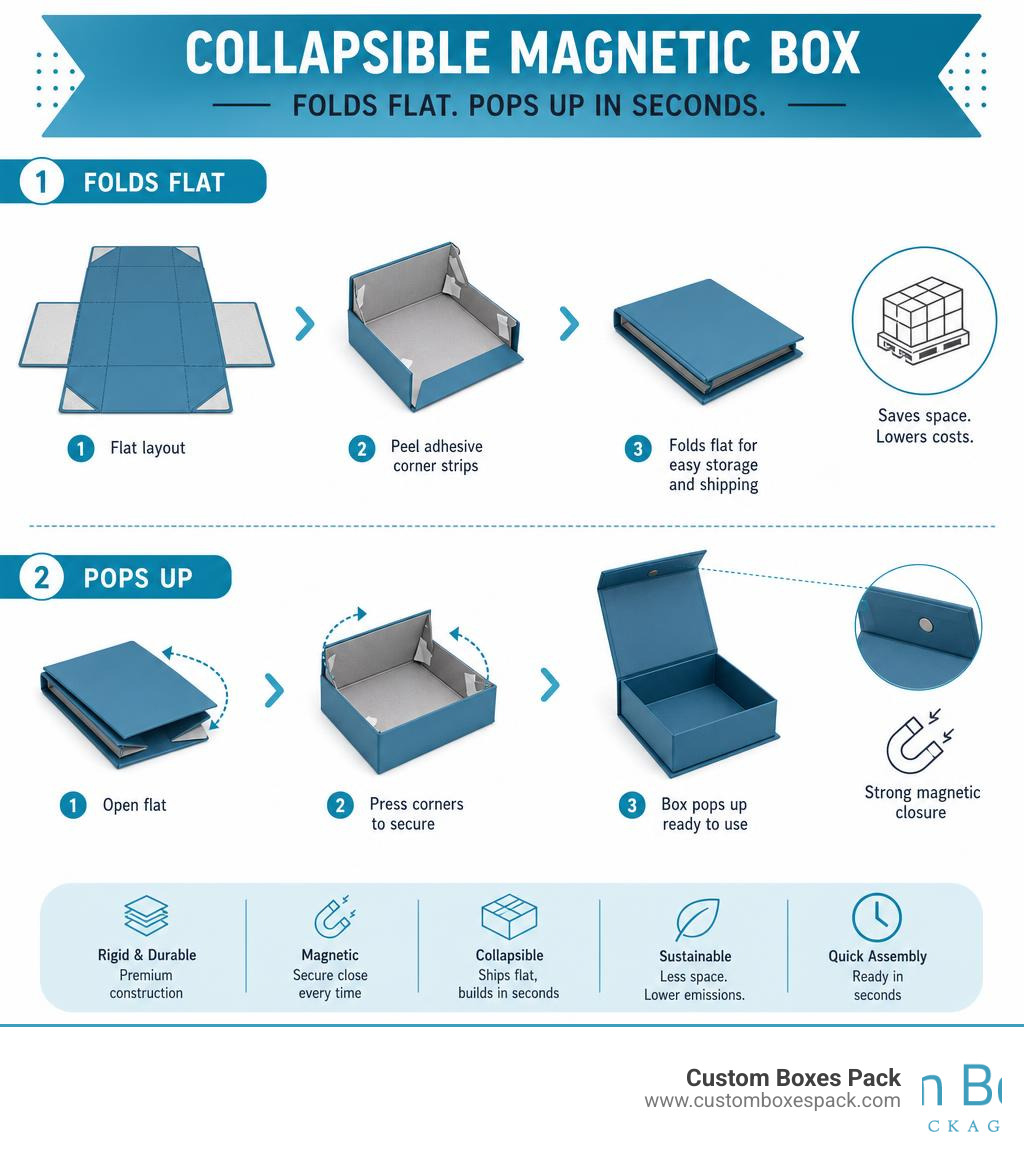
These boxes feature the exact same 2,000gsm rigid greyboard and embedded N35 magnets as standard rigid boxes, but they are engineered with clever score lines and adhesive corner strips. They ship completely flat to save on freight and warehouse space, and your fulfillment team simply peels back the adhesive backing and pops them into shape during packing.
However, there is a trade-off: assembly time.
- Pre-assembled rigid boxes require zero warehouse labor; you simply drop the product in and close the lid.
- Collapsible magnetic boxes require 15 to 30 seconds of manual assembly per box. If you are fulfilling thousands of orders a week, this added labor cost can quickly eclipse the savings you gained on shipping.
Customization, Finishing, and Sustainability
Both custom flip top boxes and magnetic closure boxes offer a massive array of customization options to make your brand stand out. Because we specialize in high-end wholesale printing, we can apply premium finishes to both structures, including:
- Foil Stamping: Metallic gold, silver, or rose gold foil to catch the light.
- Spot UV: A glossy, raised liquid coating applied to specific design elements (like your logo) against a matte background.
- Soft-Touch Lamination: A velvety exterior finish that makes the box feel incredibly luxurious to hold.
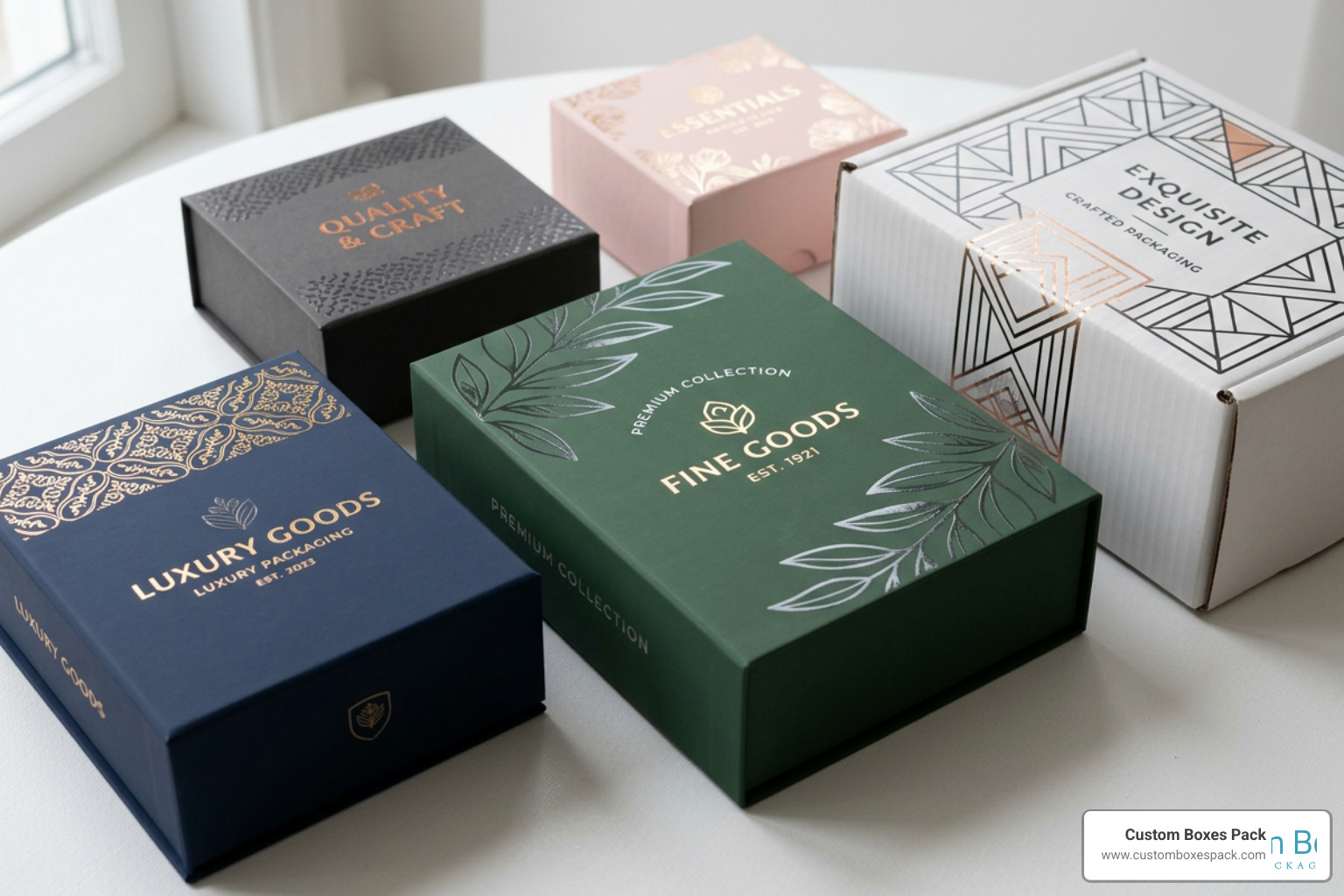
However, when it comes to sustainability, the two box styles diverge significantly.
In June 2026, eco-conscious consumerism is at an all-time high. 63% of US and EU consumers state they would pay more for products in fully recyclable or reusable packaging.
Custom flip top boxes made from kraft paperboard or corrugated cardboard are incredibly eco-friendly. They use minimal glue, are printed with soy-based inks, and can be tossed directly into standard residential blue recycling bins without any preparation.
Rigid magnetic boxes are highly reusable—customers love keeping them to store jewelry, documents, or makeup—but they are much harder to recycle. The embedded neodymium magnets are not paper-compatible in standard recycling streams. To recycle a magnetic box responsibly, the customer must manually cut the paper lining, pry out the small metal magnets, and recycle the greyboard core separately.
If your brand positioning relies heavily on a “100% zero-waste” or “fully recyclable” message, a custom flip top box printed with soy inks on FSC-certified board is your best choice.
Learn more about eco-friendly printing techniques by exploring our Custom Printed Boxes.
Frequently Asked Questions about Custom Box Closures
Are magnetic closure boxes fully recyclable?
Not automatically. While the thick greyboard core and paper wrap are fully recyclable, the embedded magnets are a contaminant in standard paper recycling streams. To make them eco-friendly, you must either instruct your customers to remove the magnets before recycling or work with us to source eco-friendly paper-based hinges or press-stud closures instead.
Which box style is more cost-effective for startups?
Custom flip top boxes are far more cost-effective for startups. At Custom Boxes Pack, we offer a low MOQ of just 100 units, free design support, and free shipping across the USA. Because flip top boxes ship flat, they keep both your initial packaging order and your ongoing shipping costs to customers highly manageable.
How do I choose the right magnet strength for my packaging?
We recommend high-grade N35 neodymium magnets for most consumer packaging. The exact size and pull force depend on the thickness of the greyboard and the weight of your product. Our engineering team conducts “shake tests” and drop tests on custom prototypes to ensure your lid snaps shut securely and won’t pop open during transit.
Conclusion
When we weigh custom flip top boxes vs magnetic closure boxes: which is better, the crown doesn’t belong to just one style.
- Choose Custom Flip Top Boxes if you are running an e-commerce store, a subscription box, or a startup. They offer incredible shipping and storage savings, excellent durability, high recyclability, and a highly customizable canvas for beautiful brand storytelling.
- Choose Magnetic Closure Boxes if you are selling high-ticket luxury items, premium cosmetics, jewelry, or curated corporate gift sets. The satisfying magnetic click, heavy rigid structure, and high-end perceived value will easily justify the higher logistics and manufacturing costs.
No matter which path you choose for your brand, we are here to bring your vision to life. Based proudly in the USA, Custom Boxes Pack manufactures premium wholesale packaging tailored to your exact specifications. With our low MOQ of 100 units, free design assistance, and free shipping, we make upgrading your unboxing experience simple, affordable, and stress-free.
Ready to elevate your product presentation? Explore our custom packaging categories and request your free quote today!